You Have One Job

Why the world needs the best you

“I believe that, as long as there is plenty, poverty is evil.”

Robert Kennedy
You Have One Job

You may have seen the hashtag #firstworldproblems on Twitter or Facebook. It usually follows a post where someone is complaining about something trivial – like a slow fast food drive through – that would only be a problem to those of us who live in the wealthy twenty percent of the world.

If you ever visit a developing or “third world” nation, it changes your perspective on everything. All of a sudden those minor annoyances don’t carry the same weight. Experiencing the pain of a mother watching her child slowly waste away is a jolt of reality that pierces our comfortable western bubble. When you return home, you are changed. The resources you have, the abilities and money you possess, seem wasted unless they are used to take care of those who live in such desperate poverty. I know it did for me.

I now see my efforts to take care of the poor as a moral obligation. As someone who has enough, it is my moral duty to share with those who don’t. As someone who has MORE than enough it is my moral responsibility to help those who can’t take care of themselves.

I also believe all of us have a moral obligation to be the very best version of ourselves. You alone possess your unique cocktail of experiences, talents, and perspectives. You bring something to the table no one else can provide…you.

The world is an amazing place, at once filled with desperate need and amazing opportunity. To give less than your best or become less than you could be robs this world of your impact. If you don’t offer your best there will be one less smile, one fewer helping hands, and a lifetime of missed chances to make a difference.

For just a moment, let’s ponder a few areas of life where becoming the best version of yourself would make an enormous impact on the world around you:

Money

Many people feel guilty about becoming financially successful, fearing they will be perceived as greedy or materialistic. Greed is definitely a danger, evidenced by the consumer culture that surrounds us.

But wanting to be financially independent is not in itself greedy or self-centered. It’s what you do with that financial independence. Money is not a zero-sum game. If you have more money it doesn’t mean that others have less. It just means you are able to do more. Money makes it possible for you to give more and invest more in the people and projects that inspire you. Financial independence allows you the time to devote to those projects. You will never build a school in Africa or have an impact through your local food bank without the finances to make it happen.

No, becoming financially successful is not greedy. Instead, you have a moral obligation to earn all you can, so you can be and do all you can.

Time

According to the Bureau of Labor Statistics, Americans spend a total of five hours per day in “leisure activities,” including television, social media, and playing games. While I think a certain amount of down time is healthy, I’m not sure five hours is making the best use of that resource called time.

What if we even took one of those hours per day and dedicated it to something meaningful, imagine what we might accomplish. That’s an extra 45 eight-hour work days dedicated to making a change in our lives, our finances or in the world around us. Seven extra work weeks instantly appeared simply by taking one hour of leisure time and committing it to something meaningful.

Small sacrifices make a big impact, that’s why making the best use of your time is a moral obligation.

Focus

You can’t do everything. Like previously mentioned, limitations of time and money can inhibit our ability to make a dent in the world around us. That’s why it’s so important to maintain our focus in all areas of our lives.

Meandering through our day, not maintaining a balance between our work and family, or “sacrificing the great on the altar of good” all make us less able to make our unique contribution on the world around us. When we allow small, insignificant tasks to take our focus from those things we were made to do, it dilutes our ability to fulfil our destiny. Saying yes to something means I’m saying no to something else.

Life is not a game. The changes we can create, the people we can help, the difference we can make demand someone who is focused on the prize. That’s why I say you have a moral obligation to say yes to what is important and no to what is not.

You Have One Job

Many times I have sat in a small, hot home in a developing nation, chickens walking through on the dusty dirt floor. And as I have looked into the eyes of those in poverty, I would consider myself an animal if I were not moved with the compassion to help the. If I have the ability, I have the obligation.

Would that we would all view the world that way. We have the ability to make a difference, and the world is in desperate need of difference makers. To do any less – to be any less – does a disservice to those whose lives we could have changed.

It’s our moral obligation.

Print Friendly

Let Kerry Patterson show you how to change anything. Click here to get your copy. "Change Anything: The New Science of Personal Success" by Kerry Patterson

On Today’s Show

Willpower is not the answer to creating change in your life. Kerry Patterson says when you have lasting problems and you’ve tried and tried, willpower is not enough. That’s where skill comes into play.  When you learn how to bring certain skills into play, depending on what challenges you are facing, you are 10x more likely to create lasting change.

Play

Subscribe in iTunes | Subscribe in Stitcher

1 Simple Thing Action:

Ask yourself the question; “What are the forces out there that are driving me to continue my bad habit?” Start logging the circumstances, influences, and forces that are moving you in the wrong direction. Be mindful of these subtle triggers so you’ll know how to guard against them.

Mentioned In Episode:

Influencer: The New Science of Leading Change by Kerry Patterson

Guest:

Kerry Patterson

  • Co-Founder, Vital Smarts
  • Best-Selling Author

facebookCLICK HERE to connect with Kerry Patterson on Facebook

twitterCLICK HERE to connect with Kerry Patterson on Twitter

linkedinCLICK HERE to connect with Kerry Patterson on LinkedIn

Review the Podcast in iTunes

If you enjoyed the show, please rate and review my podcast in iTunes. This will help tremendously in getting the word out. Thanks!

Print Friendly

This Article Was Written By

Manuel Serrano

Leave a Comment


Don't just retire. Retire Inspired! Chris Hogan can show you how. Click Here to get started. "Retire Inspired: It's Not an Age, It's a Financial Number" by Chris Hogan

On Today’s Show

When you hear the word retirement, you probably don’t imagine yourself scrambling to pay your bills in your golden years. But for too many Americans, that’s the fate that awaits unless they take steps now to plan for the future. Whether you’re twenty-five and starting your first job or fifty-five and watching the career clock start to wind down, today is the day to get serious about your retirement.

On this episode, Dave recaps episodes 386-389 where Chris Hogan shares some financial and retirement advice from his book, “Retire Inspired: It’s Not an Age, It’s a Financial Number”

Play

Subscribe in iTunes | Subscribe in Stitcher

1 Simple Thing Actions

Episode 386: Retirement starts with the dream

1 Simple Thing Action:
The dream is the vital jumping off point for retirement. We all have dreams of what retirement will look like. Do you want to travel, spend time with the grandkids, or volunteer in your community? It’s those dreams that will give you a goal to reach and work towards. If you are married, sit down with your spouse and have the “dream meeting.” Don’t poke holes in each other’s dream by saying, “You can’t do that,” or “That’s too big.” Talk about the things you have in common, and then identify what it’s going to take to get there. See your reality, identify your dream, and start to work by budgeting – understanding where your money needs to go to help you create the best for your future.

Episode 387: Retirement isn’t an age, it’s a number

1 Simple Thing Action:
Realize that retirement is not an age. It’s never too early or too late to begin saving for retirement. You have to figure out your financial number. Do your R:IQ. Get an understanding of how much money you are going to need to live that dream. And having that understanding will allow us to move forward much more intentionally and with a purpose for our future.

Episode 388: Avoiding retirement obstacles

1 Simple Thing Action:
Be aware of the retirement issues you could face: Misunderstanding retirement. Depending on social security. Acting like a sheep. Not having a plan. Don’t have an attitude of denial and avoid these obstacles. Instead, put together a plan of attack to overcome them.

Episode 389: Enemy Number One of Your Retirement

1 Simple Thing Action:
You must take the time to create a budget, get out of debt, save for emergencies, and invest for the future.

Guest

Chris Hogan

  • Chief Strategist: Retirement, Business & Leadership
  • America’s leading voice on retirement
  • Financial Coach at chrishogan360.com
  • Financial and Business Expert
  • Ramsey Personalities
  • Author
  • Speaker

facebookCLICK HERE to connect with Chris Hogan on Facebook

twitterCLICK HERE to connect with Chris Hogan on Twitter

linkedinCLICK HERE to connect with Chris Hogan on LinkedIn

Review the Podcast in iTunes

If you enjoyed the show, please rate and review my podcast in iTunes. This will help tremendously in getting the word out. Thanks!

Print Friendly

This Article Was Written By

Manuel Serrano

Leave a Comment


You Had to Be There

Northern lights over a camp north of the Arctic Circle, October 2014 Yannis Behrakis/Reuters

I bought an iPad Mini. It cost me over $400 with tax. It was great for a while. I watched movies on it, played games, surfed the net. I even tried to do work on it, but it’s not really conducive to most of what I do.  The problem is that I got an iPhone 6 Plus. The one with the big screen. Now I watch movies on that. And that $400 iPad just sits in my bag. It sits there so long I have to pull it out and charge it every once in a while so the battery won’t be dead if I need it.

This story from The Atlantic is one of many I’ve seen recently on the advantages of investing in experiences rather than objects. Like James Altucher says, “…new things go away. But experiences I can anticipate, I can enjoy, and I can remember. Trifecta!”

Print Friendly

What’s Your Playlist?

Three Ideas to Change Your Past, Present, & Future

Whether you think you can or you think you can’t,

you’re right. –Henry Ford 

playlist

I remember a few years ago seeing Tony Robbins demonstrate something amazing to his audience. You can try it yourself if you’d like, I think you’ll be amazed.

Stand up and put your hand in front of you with your thumb up, like you’re giving someone the “thumbs up” sign. Now, with your arm extended in front of you, twist your torso as far as you can, and notice where in the room your thumb is pointing.

Now, close your eyes and imagine your torso spinning freely like a top. There is no limit to the number of times your body can spin. After a few seconds of visualizing, keep your eyes closed and again twist your torso as far as you can and notice what position your thumb is in relation to the room.

If you’re like most people, you will have twisted about 10-15 percent further than the first time. I have tried this on myself and others, and I continue to be amazed.

To me, it highlights an important principle: the power of our beliefs.

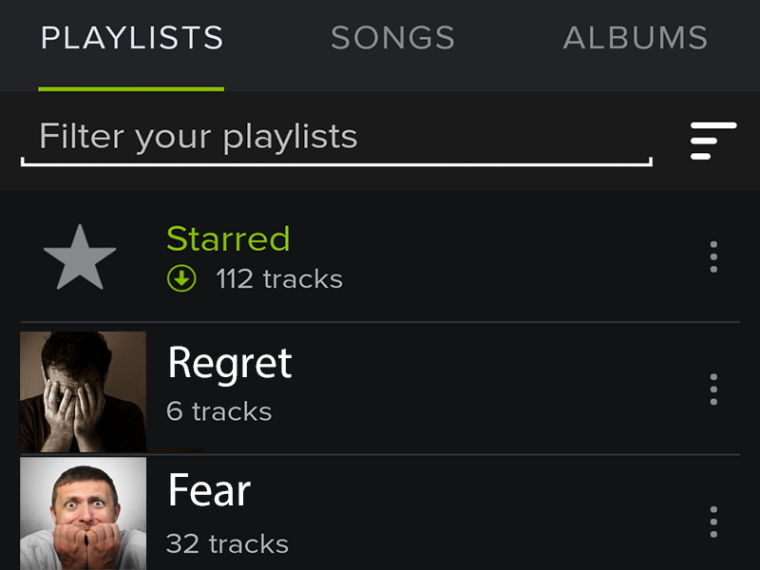
We all have messages we tell ourselves every day. They may not be conscious, but they are like a constantly repeating playlist. And for most of us, they are not messages that empower. We repeat our failures and fears. We replay the times we tripped, spoken out of turn or made a fool of ourselves. And even though we might not consciously think about them, they are there, guiding our decisions and our future.

We are constantly making what I call “micro-decisions.” These are tiny moments throughout our day that we make seemingly insignificant decisions, so small that we might not even recognize them as decisions. Speak up in a meeting or not. Eat the junk food or not. Check my Facebook or not. I’m making constant decisions to do – or not do – a myriad of things throughout my day.

Stop to consider how often those decisions are guided by the internal playlist in our minds. Past failures affect my willingness to take chances. Past conflicts might stop me from making myself vulnerable. Past mistakes can make me hesitant to try something out of my comfort zone. Then, when I do try and fail, I use that experience to reinforce my current, self-limiting beliefs.

And we don’t even think about it consciously. We just don’t do it. We write off opportunities without consideration. We turn the other way by habit. We close ourselves off even before we encounter something new. It’s just how we view the world. “I’m not creative.” “I’m not that kind of person.” “I don’t think so.”

What might happen if we paused that playlist? Or what might happen if we started a new playlist? Might our lives change? Might we find ourselves open to new experiences and opportunities? Might we find the success we’ve been hoping for?

But how do you change the playlist. If were that easy, why wouldn’t we do so? Wouldn’t everyone do so? It’s not automatic, but there are some strategies you can put in place to begin slowly transforming those negative beliefs and expectations into something positive.

Rethink Your Past

In the movie “Pretty Woman,” the characters Vivian and Edward, played Julia Roberts and Richard Gere, are lying in bed talking:

Vivian: People put you down enough, you start to believe it.

Edward: I think you are a very bright, very special woman.

Vivian: The bad stuff is easier to believe. You ever notice that?

The bad stuff is easier to believe, and to remember. That internal playlist rarely contains memories of our good moments. The times we have succeeded are usually not on the list. It’s the failures and mistakes that are easier to remember and believe.

Instead, create a playlist of positive memories. Think about the times you have tried and succeeded. Think about the people who have respected and looked up to you. Think about your wins, not your losses. Make a list of those times. Seriously, write them down and keep the list. Refer to it when you’re feeling bad about yourself or when you catch yourself in a self-limiting pattern of fear.

Rethink Your Present

Oprah Winfrey once said, “Surround yourself with only people who are going to lift you higher.” That’s good advice. With whom are you surrounding yourself? What are you reading? Who is speaking into your life?

If Jim Rohn’s axiom that “you are the average of the five people with whom you spend the most time” is true, then it might be time to evaluate who those five are. Are they inspiring and pushing you toward your goals? Do they fill you with joy and expectation of the future? Or are they reminders of where you’ve been?

Rethink your village. You might have to say goodbye to some friends. You might have to pause some relationships. You might have to make decisions about those in your life who are holding you back and those who are propelling you forward.

And it’s not just people. What books are you reading? Which films and shows are you watching? What music do you listen to? We all know how a song can instantly transport us to a memory. How much time do you want to spend in those memories? How much time do you want to spend reading or watching things that don’t push you forward. I’m not discouraging entertainment. We all need times when we just turn off our brain and enjoy some mindless mental comfort food. I’m talking about the constant messages and influences you are allowing to affect you. We have to get intentional about those interactions, or they will never change. And if they never change, we will never reach our fullest potential.

Rethink Your Future

In 1989, a psychologist named Robert Zajonc published one of the most significant studies on the emotional effect of smiling. His results showed just smiling at yourself in a mirror can cause happy feelings. Imagine what might happen if we accompanied that smile with powerful, positive affirmations of our future.

Many people hear the word “mantra” and think of something mystical and metaphysical. But that’s not necessarily the case. You most likely are already repeating mantras to yourself every day. They’re those limiting thoughts and beliefs.

Since you are already repeating messages to yourself, why not make them positive. Why not fill your mind with belief instead of unbelief, courage instead of fear, expectation of good, not bad. I can instead of I can’t.

Write down messages on cards and carry them with you. Post them on the bathroom mirror. Make them your screen saver. Bombard yourself with messages that inspire hope and expectation. They may seem unrealistic or untrue. That’s ok. Speak what you dream. Speak beyond what you think is possible.

Money flows to me in abundance.

I’m making decisions every day that lead me to my goals.

I’m constantly seeing my dreams come true.

Again, it’s not metaphysical woo woo. It’s training your brain to expect good instead of bad. And as you fill your mind with those thoughts, your micro-decisions begin to change. You begin to see reality taking the shape of your expectations.

Your thoughts determine your decisions, your decisions determine your actions, and your actions determine your destiny. Become intentional about looping a mental playlist of positive messages that empower you to reach your potential. Put the playlist of failure and fear on pause and see how your life changes.

Print Friendly

What Else Can You Do?

CanYouReadThis

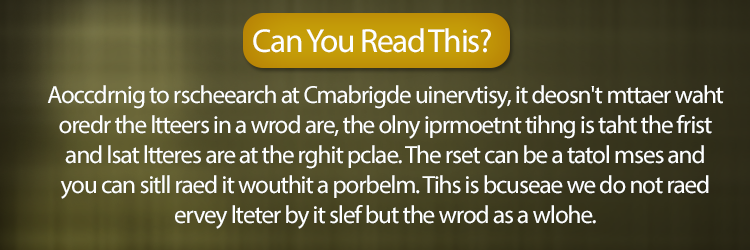
This bit of linguistic gymnastics circulated the internet a few years ago. There’s some debate as to whether there was ever research done on this topic at Cambridge (they say there wasn’t), but it’s valuable nonetheless.

Isn’t it amazing that our brain can decipher those words, even though most of the letters are out of order. Researchers argue about why it is. The first and last letters have something to do with it. So does context, both within the words and within the paragraph as a whole. Notice many of the articles – the, and, a – are correct. These give the sentences a sense of continuity and add context that helps us anticipate the next word.

But I’m not writing this post to discuss how your brain makes sense those letters and allows you to read the paragraph. Instead, I want to point out a couple of things we can learn from it.

You can do more than you think you can

We all have a story we tell ourselves about ourselves. It’s the narrative that gives us identity. That can be a good thing many times. If we identify ourselves in a positive light as someone who is worthy, capable, honest or creative that story can be an effective tool to push us forward in our lives. If that same story is one of failure, fear, and regret it can limit us and hold us back from all that is on our horizon.

If someone were to ask you, “I’m going to mix up all the letters in a paragraph, do you think you’ll be able to read it?” I’m sure the answer would be no. Your experience in this world – your story – told you that’s impossible. But you did. What you didn’t think possible was indeed possible.

So how many other opportunities or challenges have you summarily dismissed because you thought they were impossible? Write a book? I’m not smart enough. Start a business? I’m not savvy enough. Publish a blog? I don’t know how. How many times have you made an excuse simply because you thought you were not qualified? How many times have you been afraid to speak because you thought you were not worthy?

Life is an endless menu of possibilities. How many do we miss because we count ourselves out before we even try? We instantly assume we are incapable of deciphering the letters. That’s the story we’ve told ourselves about ourselves. And unfortunately we often tell ourselves we know the end of the story before we begin writing it.

You don’t have to have everything in order to start

You read that paragraph with the letters jumbled. You didn’t have to straighten out each word and make it perfectly correct before you were able to begin reading. Your brain got you through it even though it wasn’t perfect.

Have you been holding back from your masterpiece because you think everything must be in order first? In most cases that perfectionism is just a manifestation of your fear. Nothing will ever be perfect. Circumstances will never be ideal. And if I wait for everything to be perfect then I don’t have to begin. It’s my safety zone. I can’t fail if I don’t start.

But just like you looked at that paragraph, and the words began falling into place for you, so it will be in life. Just begin, and you’ll be amazed at how things will begin to make sense. Not instantly, not necessarily easily, but eventually the details begin to become clear. The world seems to align itself for those who are willing to move forward in the face of their fear.

So what does your story say?

Scientists have identified something they call the “default mode network” in our brain, the DMN. It’s the self-talk and internal narrative we use to define our lives. It’s our default mode of thinking about ourselves and our world. It’s our story we tell ourselves about ourselves.

What does your DMN say about you? Do you even know? The first step in starting to redefine our story is to know what it says. That’s where the practice of mindfulness comes in. Mindfulness is the ability to be in the present moment, observing our thoughts and emotions without judgment.

Let’s get mindful right now. What does your internal narrative say about you? Does it tell you how capable, intelligent and able you are to handle challenges? Does it say you are creative, courageous and worthy of success? Or does that voice in your head remind you of all your failures, faux pas, and foibles? Does it tell you not to try new things because you might fail? Does it call you stupid or incapable?

Allow yourself the freedom to admit who you are without judgment. Beating yourself up for beating yourself up isn’t very productive. Your brain is not your enemy; it’s trying to help you. By defining certain generalities and default modes, you are more capable of easily navigating the complexities of life. But those generalities are often built on the foundation of half-truths and insufficient information.

Here’s the truth: even successful people struggle with doubts. They are part of our human experience, part of that DMN. The difference between us “down here” and them “up there” is they have learned to disregard the DMN and replace it with a new story. In the beginning, the story sounds like a lie like you are just fooling yourself. And perhaps you are. But eventually the lie will begin to feel more like truth as your DMN begins to develop new neural pathways and rewrite your story.

Just remember this: you read that paragraph. Full of mixed up letters that, on first glance, looked like gibberish. But you surprised yourself and read the paragraph. Your DMN told you it’s impossible to read words when the letters are out of order, but you did. That narrative was wrong. And if that narrative was wrong, what other stories you tell yourself about yourself are also wrong.

You won’t know by sitting still. The world has a way of aligning itself for those who are willing to step forward in the face of their fears.

Did you enjoy this post? Please leave a comment below, and share it with your friends on social media.

Print Friendly

Let Richard Shell be your guide on your own personal success journey. Click here to get your copy. "Springboard: Launching Your Personal Search for Success" by Richard Shell

On Today’s Show

Richard Shell helps us appreciate the different kinds of happiness. He reminds us to recognize that you’re likely to be somewhat mistaken about it sometimes, and just let life flow. Let the experience of your life guide you to what brings you the greatest sense of satisfaction and connection.

Play

Subscribe in iTunes | Subscribe in Stitcher

1 Simple Thing Action:

Put yourself in a position where you can feel happiness. Then make a commitment not to chase after it too hard, but just recognize when it happens. Allow yourself to be happy in whatever situation you find yourself.

Guest:

Richard Shell

  • Thomas Gerrity Professor of Legal Studies, Business Ethics, and Management at the Wharton School of Business
  • Director of the Wharton Executive Negotiation Workshop and the Wharton Strategic Persuasion Workshop
  • Award-Winning Author
  • Speaker
  • Consultant

Review the Podcast in iTunes

If you enjoyed the show, please rate and review my podcast in iTunes. This will help tremendously in getting the word out. Thanks!

Print Friendly

This Article Was Written By

Manuel Serrano

Leave a Comment


What’s In The Rearview

How to turn your regrets into inspiration

The best time to plant a tree was 20 years ago. The second best time is now. –Chinese Proverb

Rearview

That bully you didn’t stand up to.

The person you were too afraid to ask for a date.

The school plays you missed.

The stock you didn’t invest in.

The business opportunity you didn’t take.

The list could go on, probably forever. All of us have regrets. We can all look into our past at the fear that held us back or the times we took the easy way out. Those decisions can haunt us.

Most of us have said the words, “I’m going to regret this in the morning!” Too much to drink or not going to bed on time are not the wisest decisions, but after a brief regret when the alarm goes off, we’re back to our normal life. Most of us, however, have probably not said, “I’m going to regret this on my deathbed” nearly enough.

You may have heard of the book “The Top Five Regrets of the Dying” by Bronnie Ware, a nurse from Australia. As she cared for people in their final stages of life, she had the chance to ask them about their greatest regrets in life. The answers she heard, I think, resonate with all of us:

I wish I had let myself be happier

“This is a surprisingly common one. Many did not realize until the end that happiness is a choice. They had stayed stuck in old patterns and habits. Fear of change had them pretending to others, and to themselves,  they were content when deep within, they longed to laugh properly and have silliness in their life again.”

I wish I had stayed in touch with my friends

“Often they would not truly realize the full benefits of old friends until their dying weeks and it was not always possible to track them down. Many had become so caught up in their own lives that they had let golden friendships slip by over the years.”

I wish I’d had the courage to express my feelings

“Many people suppressed their feelings in order to keep peace with others. As a result, they settled for a mediocre existence and never became who they were truly capable of becoming. Many developed illnesses relating to the bitterness and resentment they carried as a result.”

I wish I hadn’t worked so hard

“This came from every male patient I nursed. They missed their children’s youth and their partner’s companionship. Some women also spoke of this regret, but all of the men I nursed deeply regretted spending so much of their lives on the treadmill of a work existence.”

I wish I’d had the courage to live a life true to myself, not the life others expected of me

“This was the most common regret of all. When people realize that their life is almost over and look back clearly on it, it is easy to see how many dreams have gone unfulfilled. Most people had not honored even a half of their dreams and had to die knowing that it was due to choices they had made, or not made.”

Yeah, that’s me!

I see myself in every one of those five regrets. Plus I have a few more I can throw in on top of those for good measure. We all can. The problem with regrets is that we often don’t recognize those actions until it’s too late. We just get caught up in life, we don’t even think about the long-term impact of our daily lifestyle and decisions.

At least not until now. We can start being intentional about our lives and make sure we minimize those regrets when we get to the finish line. You can’t do anything about the mistakes you’ve made, but you can start today to redeem them with better decisions, decisions that are true to the person you want to be.

One of my guiding principles in life came from my dad. He always told me the stories of his regrets, chances he didn’t take. He warned me to not let my life get to it’s end with dreams unrealized or chances not taken. I decided a long time ago I’d rather end my life with a thousand failures that one regret.

I’m sure we’ll all die with regrets. There is no avoiding it because we are all human. None of us will have perfect lives or spotless records. There will be glitches and hitches, blots and spots. But it’s never too late to start being intentional about how we live our lives.

The only thing worse than not starting 20 years ago is not starting now.

Print Friendly

Let Kerry Patterson show you how to change anything. Click here to get your copy. "Change Anything: The New Science of Personal Success" by Kerry Patterson

On Today’s Show

If you’ve tried and failed to create lasting change in your life, it might be because you have relied primarily on willpower. And willpower will consistently let us down. Instead, Kerry Patterson has made a career of studying the science required to make lasting change. Today Dave Kirby recaps his conversations with Kerry on Episodes 301-304 and shares some thoughts about what he’s learned.

Play

Subscribe in iTunes | Subscribe in Stitcher

1 Simple Thing Actions:

Episode 301: Willpower is Not Enough

1 Simple Thing Action:
Ask yourself the question; “What are the forces out there that are driving me to continue my bad habit?” Start logging the circumstances, influences, and forces that are moving you in the wrong direction. Be mindful of these subtle triggers so you’ll know how to guard against them.

Episode 302: Creating Lasting Change

1 Simple Thing Action:
Keep a log of what upsets you. Identify trigger points. What went on when you made that bad choice and was there a skill required to overcome that problem? Record it. Identify it. And deal with it differently next time.

Episode 303: Overcoming Bad Habits

1 Simple Thing Action:
Look at the physical world around you and how it is influencing you, because once you create those changes they become lasting.

Episode 304: How to Change Anything

1 Simple Thing Action:
Admit to the fact that you are currently blind and outnumbered. Admit to the fact that you have fallen into the motivation trap. Then seek the proper skills and strategies you need to truly create lasting change.

Guest:

Kerry Patterson

  • Co-Founder, Vital Smarts
  • Best-Selling Author

facebookCLICK HERE to connect with Kerry Patterson on Facebook

twitterCLICK HERE to connect with Kerry Patterson on Twitter

linkedinCLICK HERE to connect with Kerry Patterson on LinkedIn

Review the Podcast in iTunes

If you enjoyed the show, please rate and review my podcast in iTunes. This will help tremendously in getting the word out. Thanks!

Print Friendly

This Article Was Written By

Manuel Serrano

Leave a Comment


Nothing Found

It seems we can’t find what you’re looking for. Perhaps searching can help.